


09. Feb.. 2026

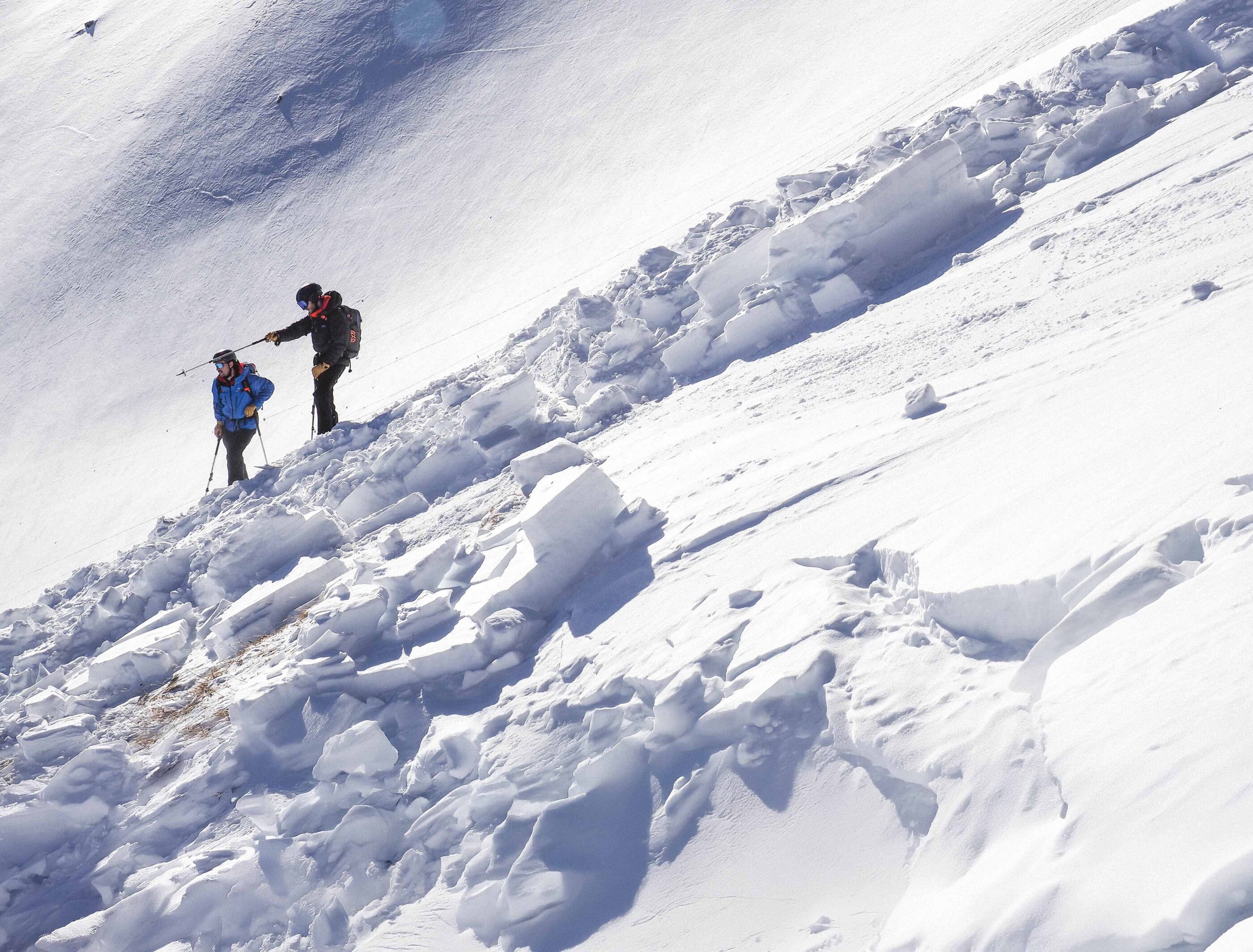
Electromagnetic interference can shorten reception range, destabilise search indications, and even create ghost signals. The familiar 20 cm and 50 cm rules are useful starting points—but in a dynamic search, distance alone is not enough. The recently published paper by Ortovox employee Dieter Kotlaba proposes a six-step process for testing, recognising and responding to interference.
Avalanche transceivers are highly sensitive receivers. In search mode, they must detect weak 457 kHz signals from buried devices and convert them into reliable distance and direction information. That sensitivity is essential for range, but it also makes the device vulnerable to electromagnetic interference from nearby electronics, metallic or magnetic objects, infrastructure, and even atmospheric electrical activity.
The effects depend on the specific combination of transceiver and interference source, the distance, the source’s operating state, and the transceiver’s mode. In the worst case, interference can delay detection, cause signal dropouts, produce misleading indications, or generate false-positive “ghost” signals—costing time and, in an avalanche with no buried subjects, prolonging rescuers’ exposure to further avalanche danger.
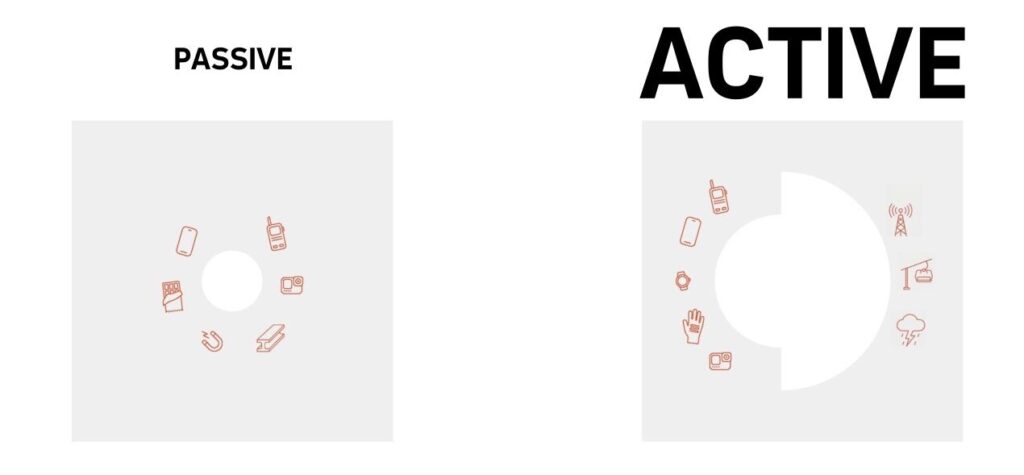
Passive interference comes from metallic or magnetic components: carabiners, ice screws, metal-containing packaging, magnets, or the internal hardware of electronic devices. Even a switched-off smartphone can matter passively. In transmit mode, such objects can detune the transmitting circuit or alter the radiated field, reducing effective transmit range. Relevant passive effects from body-worn equipment appear mainly at very close range—below about 3 cm.
Active interference, by contrast, requires an electrical or electronic source to be operating. Smartphones, radios, digital watches, cameras, GPS and satellite communicators, headlamps, power banks, heated clothing, electronic airbag systems, and snowmobiles can all generate interference. So can lift installations, power lines, snowmaking equipment, transmission masts, and other infrastructure. The effect cannot be predicted reliably from device category alone: design, operating state, battery charge, temperature, spatial arrangement, and distance all matter.
Crucially, interference effects fall off steeply with distance—approximately with the third power. Halving the distance can make the interference roughly eight times stronger.
The established recommendations—at least 20 cm in transmit mode and at least 50 cm in search mode—remain sound practical minimums. In transmit mode, 20 cm is an effective practical measure for generally avoiding relevant passive interference in the immediate vicinity. Modern transceivers may also warn users about transmit impairment and, in some cases, compensate technically; these functions are useful, but they are fallbacks, not substitutes for sensible equipment placement.
Search mode is more demanding. The 50 cm rule reduces the likelihood of relevant active interference, but it is not a physical boundary or a guarantee. Studies found that smartphones at 25 cm could substantially reduce reception range and cause signal dropouts; some effects were still observed at 40 cm. Certain digital radios may remain relevant at even greater distances.
The practical problem is that 50 cm is difficult to maintain consistently during a real search. The searcher moves over uneven terrain, changes body position, and holds the transceiver in front of the body. A smartphone in a trouser pocket, a radio on the chest harness, or a device in the hand may be well over 50 cm away while standing still—but much closer during a stride, when raising a leg, or when switching the transceiver from one hand to the other.
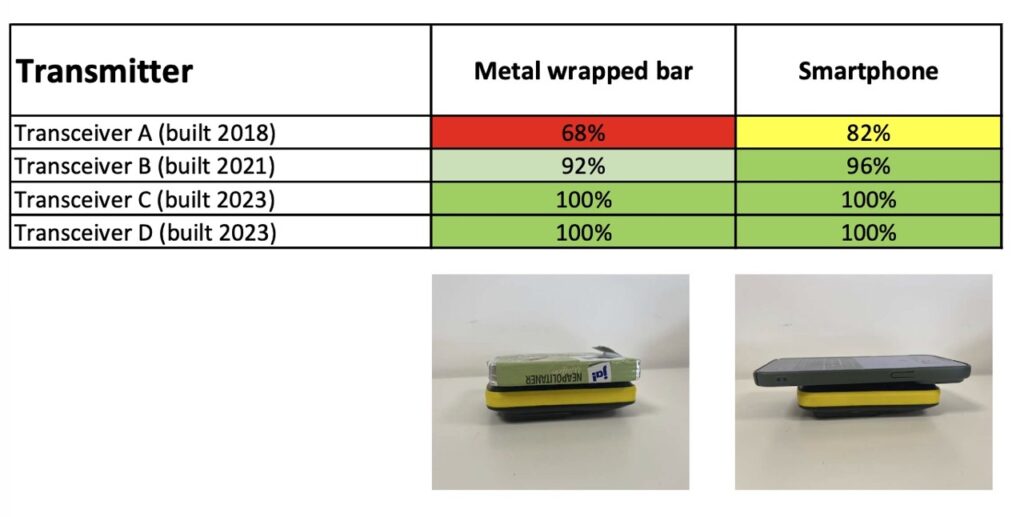
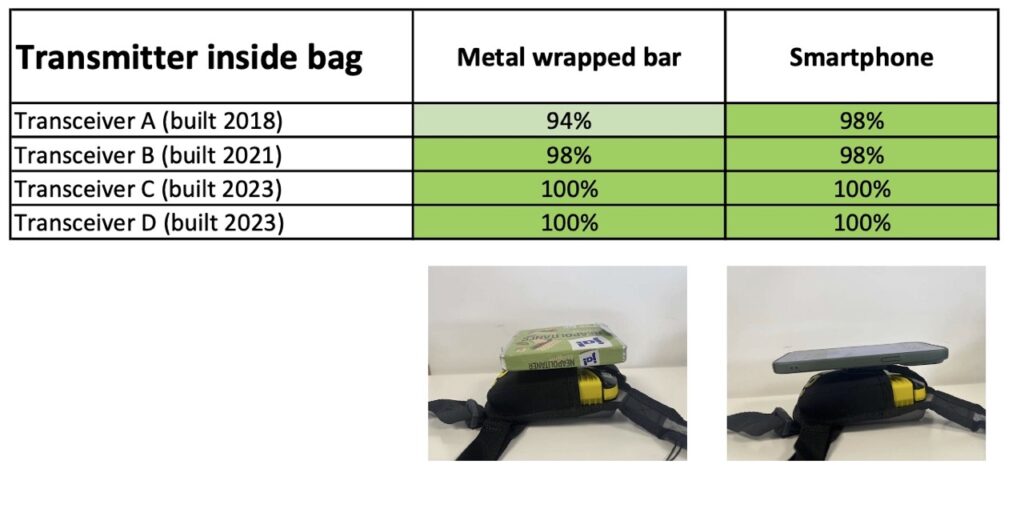
The key question is not simply whether someone carries a smartphone, radio, or camera, but wheret hey carry it and how they handle the transceiver.
A smartphone in a suitable backpack compartment can allow a greater and more consistent distance than one carried in a trouser pocket. If a pocket is used, the pocket on the side away from the transceiver is preferable; the pocket on the transceiver side is less suitable because leg movement changes the distance. Keeping the searching arm extended during the signal search and coarse search also increases separation from body-worn electronics—but user observations showed that even people trained shortly beforehand did not maintain this position consistently. A recommendation only works if it becomes a trained movement pattern.
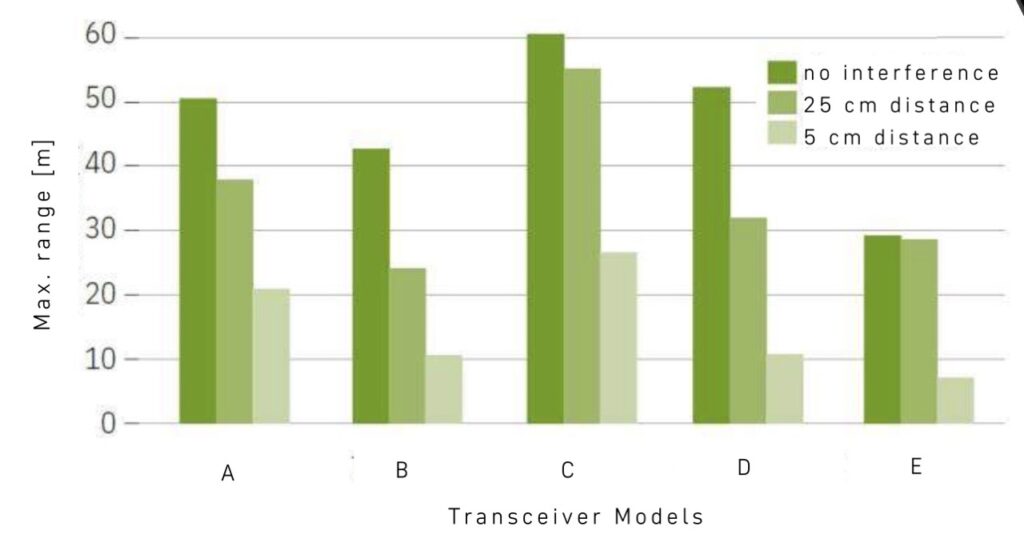
Switching devices fully off eliminates their active interference, though metallic or magnetic components can still cause passive effects at very close range. But blanket “switch everything off” advice has trade-offs: a smartphone may be needed quickly for an emergency call or coordination. Handing devices to a non-searching person is another option, where personnel and time allow. The best solution depends on the group, the equipment, and the planned search role.
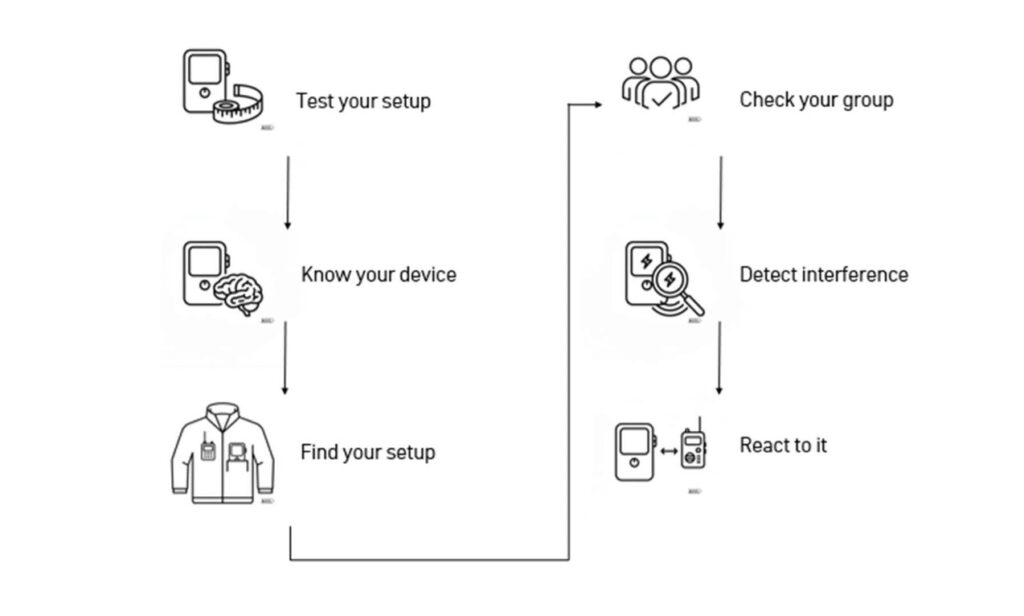
Because no single distance rule covers every situation, the author proposes a conceptual six-step process for advanced users and organised rescue teams:
If interference persists, the author suggests considering narrower search strips—potentially around 3–5 m in extreme cases—and reducing coarse-search speed, with roughly 0.5 m/s proposed as a reference value when device behaviour is unstable.
The 20 cm rule in transmit mode is an effective practical measure for generally avoiding relevant passive interference in the immediate vicinity. The 50 cm rule in search mode is equally important—but it should be treated as a planning and behavioural guideline, not a guarantee. Effective interference management combines sensible carrying positions, trained handling, device-specific knowledge, group checks, and the ability to recognise and react to unusual transceiver behaviour.
The proposed process is a conceptual framework rather than an empirically validated standard procedure. Still, it is highly relevant for experienced users: know your equipment, test your setup, and treat interference as something to manage actively—not merely a distance rule to remember.
Kotlaba, D. (2026). Know your enemy. Know your technology – A process-oriented approach to mitigating interference effects during avalanche rescue. In Proceedings of the International Snow Science Workshop 2026 (pp. 1026–1033).
Wallner, B., Caramazza, F., Woyke, S., Winkler, M., Regli, I. B., Mair, P., Putzer, G., Strapazzon, G., Falk, M., Brugger, H., & Hüfner, K. (2025). The effect of automated verbal commands during avalanche transceiver search on acute mental stress and arousal—A mixed-methods crossover field study. Brain and Behavior, 15(7), Article e70684.
Wallner, B., Woyke, S., Winkler, M., Caramazza, F., Regli, I. B., Putzer, G., Strapazzon, G., Falk, M., Brugger, H., Hüfner, K., & Mair, P. (2025). Avalanche transceiver search times during avalanche companion rescue—A prospective randomized single-blinded cross-over simulation study. Resuscitation Plus, 26, Article 101065.
Du möchtest keine Neuigkeiten mehr verpassen?
Bleib in Kontakt, mit unserem Newsletter!
